
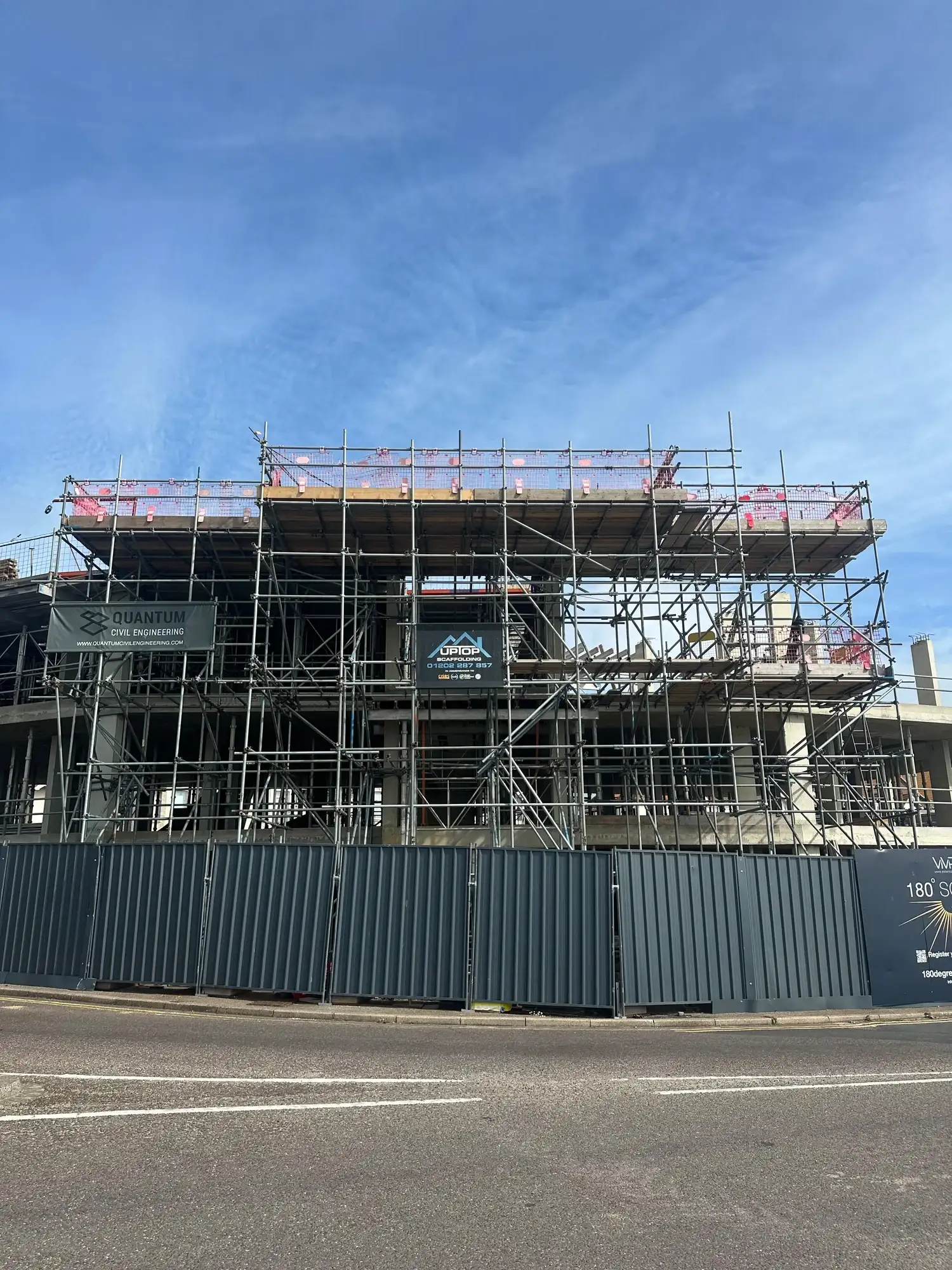
Dead Shores Scaffolding
Dead shores are temporary vertical supports used to carry loads while part of an existing structure is altered or repaired. Their purpose is structural support, rather than providing a working platform. If your project in Poole involves an opening, damaged load-bearing masonry or another significant alteration, discuss the engineer's temporary works requirements alongside the access needed to carry out the job.
- Free QuoteTell us about your project
- Fully InsuredScaffolding cover
Get a Free Quote
UP TOP SCAFFOLDING
Supporting loads during a change
A wall or floor may depend on elements that the proposed work will remove or disturb. Dead shoring creates an agreed temporary route for those loads while the permanent construction changes. That route must be understood from the supported building element all the way down to a suitable bearing surface; choosing a prop by appearance is not a design method.
The arrangement may involve needles or other members carrying loads into vertical supports. The precise solution is for a competent temporary works designer to determine. An access scaffold beside the building should not be treated as a substitute, and an existing floor should not be assumed capable of supporting concentrated temporary loads without assessment.
Dead Shores Scaffolding questions, answered.
Straight answers from the Up Top Scaffolding team before you arrange a survey or quote.
Ask us anythingAre dead shores an access scaffold?
No. Dead shores have a structural support duty. Working platforms may be needed alongside them, but access and support must be specified and coordinated as separate functions within the temporary works arrangement.
Can work begin while the support design is being prepared?
Work that depends on temporary support should not begin on an assumed arrangement. The relevant design, installation checks and permission to proceed need to be established before supported elements are disturbed.
Does the floor beneath the shores need checking?
Yes, its ability to receive the temporary loads must be assessed. Loads may need to pass through several levels or into a suitable foundation, so the visible floor finish is not enough information.
Who decides when dead shores can be removed?
Removal follows the agreed design and control process, including confirmation about the permanent work. It should not be decided simply because the new masonry or structural member appears complete.
Discuss your site in Dorset or Hampshire
Our Poole base serves projects in Bournemouth, Christchurch and the surrounding Dorset and Hampshire area. Share the site address and the work you need to reach so we can consider the access arrangement for your project.
Openings, repairs and restricted sites
Typical enquiries can arise when a contractor proposes a new opening in a load-bearing wall, local rebuilding beneath an existing structure or repairs to deteriorated support. The scope needs to distinguish between supporting the building and giving the contractor room to work. Both may be required, but their duties must not be blurred.
Occupied rooms, basements and narrow plots can make the temporary arrangement difficult to accommodate. Share drawings showing the full structure above and below the work, not only the proposed opening. Information about services, weak floors and the sequence of adjoining operations helps the designer identify issues that are not apparent from the visible face of a wall.
Follow a defined installation sequence
Up Top can discuss the scaffold and temporary support enquiry with your contractor, with specialist responsibilities agreed before work is accepted. The design brief should identify who assesses the existing building, who prepares and checks the temporary works and who controls each stage. Agreeing those roles avoids relying on assumptions between the builder, engineer and scaffold team.
Installation, checks and any controlled transfer of load must follow the approved specification. The supported structure should not be altered before the necessary acceptance is in place. Inspections during the works need to consider movement and changing site conditions. Release and dismantling are equally deliberate stages, taking place only when the permanent work and the responsible designer's requirements allow the support to be removed.
Keep support separate from access
Temporary support must not be modified to create room for materials or make an opening easier to use. Even a small change in the support position can alter how the building's load is carried. Tell the responsible person immediately about movement, damaged components or a conflict between the agreed arrangement and the work being attempted.
Where access platforms, ramps or material handling are also needed, their loads and connections must be coordinated with the shoring scheme. A dead shore is not a general-purpose scaffold standard, and the safe capacity of a component cannot be separated from the stability and bearing conditions of the complete temporary works arrangement.
Related access for your project
Coordinate this enquiry with support scaffolding, propping and access ramps and façade retention. Builders should provide the engineer’s scope and planned alteration sequence.
Verified Feedback
What Our Clients Say
Read verified reviews from customers across Dorset & Hampshire.
Request a dead shores scaffolding quote
Send photographs, the proposed work dates and any available drawings with your enquiry. Tell us about access restrictions and the intended hire period. Use the quote form to discuss the next step for your site.